Now and Then

The last time I posted was two months ago, and that post, like this one, had to do with my experience as a student at St. Paul’s School. Truly, I am not obsessed with the place, and it isn’t all I think about. So if you’re new to the blog, dip back into the archives for other topics, or stay tuned for something new and different in the coming weeks.

To be honest, I was a bit spooked by the warmth of response to the prior piece, which dealt with sexual misconduct at the school. Don’t get me wrong, I was so appreciative that people a.) read it and b.) took the time to reach out to me with such supportive thoughts.   Thank you, thank you, if you’re still reading and haven’t found a more gripping distraction over the past two months, like the Trump-Warren Twitter battle. I admit I was taken aback to suddenly find myself in conversation with readers, and the private side of my nature was a skootch overwhelmed. So I curled up for a little while to recharge and live my life, working on other projects and concerns. I never intended to reintroduce myself to posting with another prep school story. But whatcha gonna do? It’s the work that’s before me: I got an assignment from no less a personage than my lovely St. Paul’s friend, Els Collins.  (We also went to Princeton together, but we drifted.  Silly girls.)   This week, we spent an afternoon on the Cape together, along with our SPS/Princeton classmate Nora, and before leaving, we agreed we’d each write about it.   Here’s the link for Els’ reflection.

Nora is a reluctant writer, which has nothing to do with ability and everything to do with confidence.  I hope to share her “assignment” here some day soon.   Here goes with mine:

F0rest.beachMonday was a beautiful day, in every way. After a crap spring of cold and drear, we’ve emerged into a halcyon June, enjoying days of 70˚ sunshine, crisp blue skies and fruity sunsets. It was perfect beach weather, sunny, breezy, and comfortably warm.  Nora and I programmed “Chatham” into Waze and hit the highway for the Cape, excited to visit Els, here from LA. She’s vacationing for a week with her husband Jimmie, their 27 year old son Chris (instantly likeable), along with his fiancée and their six month old baby girl.   (Omigosh: So entrancing.) We endured–or relished, depending on which one of us you ask–our teens together in a unique and cloistered school, St. Paul’s. Now and then, it’s a place of light and shadows, and each of us stood at a different exposure on that spectrum.

In the ‘70s, we girls clonked to class in our Frye boots, worrying about our grades, our crushes, our happy-sadness, our vulnerabilities.   Not terribly different than my Frye-sporting daughters now, although sans social media, thank God. We binged on late night ice cream or pizza, we told risqué jokes about experiences few of us yet had, we gossiped. We sang, played flute, acted in plays, and competed in sports. (Well, Nora and Els may have competed in sports. I slipped off to daydream.) Our soundtrack was Fleetwood Mac, Earth, Wind & Fire, Boz Scaggs, The Boss.  Strains of “Born to Run” wafted out of our dorm windows across grassy expanses. The ponds were ice-cold and the autumn colors took your breath away, even when you were so homesick you wanted to puke, but home wasn’t a place you could go back to, because your parents were divorcing. Plenty of our classmates smoked: cigarettes, weed, hash. I was too much of a rule-follower for that, but the repressed rebel in me secretly delighted in the risk-seeking antics of some of my racier peers. In the evenings, before we had to check in to our dorms for the night, we’d trek through the starry cold to the “Community Center”, a rustic skating shack, to socialize and smoke. The CC, as we called it, was daily restocked with a selection of Dunkin’ Donuts, delivered by cab from downtown Concord. To this day, the sight and smell of a croeller immediately evokes a cocktail of ambivalence: anxiety, mischief, freedom, joy. Another era.

And now we find ourselves at 56. Between us, we share nearly ninety years of marriage. Each of us is still yoked to the same guy we started out with. Els cares for her husband of thirty-one years, Jimmie, with unfussy grace and deep affection. At 89, he is a man of extraordinary charm and vigor, with a mischievous cast to his wit that makes me wish I knew him when he was my age, with three decades of friendship ahead of us. He’s no slouch: he remembers Beckett’s plays with far more clarity than I do, and I’m thirty-three years younger and wrote my undergraduate thesis about them.  A lifelong character actor, he just finished a celebrated run of the playwright’s “Endgame” in LA; he worried that his memory would trip him up, but it didn’t. Sitting across the shady lunch table from his adorable baby granddaughter, Jimmie got misty-eyed. He recalled a role he played in his thirties that demanded he relive his vulnerability as a 17 year-old. Time folds, unfolds, recapitulates, and shuffles—or lurches—forward. Or backwards. It’s all the same, even as things “change.” Beckett understood.

After lunch, Nora, Els and I headed for the beach, leaving Jimmie and “the kids” at the house. It’s a quick stroll: a couple of turns down charming Cape lanes with names like “Tobey Turtle’s Way” and “Aunt Deborah’s Lane,” beautiful marsh views unfurling as you head downhill towards the beach. On the way, Els confided that given the thirty-three year difference in their ages, they didn’t count on Jimmie being here to meet a grandchild, although of course they hoped for it. We asked her how she is faring, caring for a spouse in such a different life stage. “I’m just thankful for every day we have,” she answered, and there was nothing put-upon or saccharine in her response. “We’ve always known it would be like this for us at this point. But I’ve gotten to spend thirty-one years with someone I loved so much. So every day is a gift.”

If you’d asked me, forty years ago, which of my prep school friends would make an unconventional but utterly authentic choice of spouse, I would have told you, “Els Collins.” Even then, Els had an easy self-possession that I admired. She was grounded and funny, original and independent. We didn’t become close friends until late junior year, when I was still coming into myself. My sophomore year (we called it “Fourth Form” at St. Paul’s), I felt like a square peg in a round place and time of life—I was sensitive and dramatic, lonely for genuine connection, non-confrontational, with an irreverent wit escaping in exaggerated bursts that took me by surprise, like a button popping off your shirt, exposing your bra.  In contrast, Els embodied natural calm and authenticity. It’s no wonder she has enjoyed a long and fulfilling career in theater as a stage manager, both in practice, and as a teacher.   Most importantly, she has always been kind. That was not a quality expressly cultivated by St. Paul’s. But boy, did you ever appreciate it when it crossed your path.

Nora, more like me, was a raw nerve in adolescence. She inhabited the difficult space of being both a student and the elder daughter of the stentorian classics teacher at the school, a campus personality of great uprightness. St. Paul’s was her childhood home and her high school community. Navigating the shoals between those two shores wasn’t easy.   Only my closest friends knew anything about my dysfunctional family back home—my mother’s recovery from alcoholism, my father’s anxiety, my brother’s expulsions and arrests. But Nora’s quirky clan could be observed up close in our shared habitat: her emphatic, ramrod-straight father and fragile mother, a boundary-testing younger sister, a tow-headed and beloved young brother, whom the family tragically lost to a cycling accident in his twenties. Nora wrestled with how she fit into the rarified milieu of St. Paul’s, with so many of us hailing from places like Greenwich, Lake Forest, or the posher zip codes of Manhattan. Yet she fit everywhere, with the other faculty kids, the local boarders from Concord, the preppier rowers, the highbrow academics.

Nora’s intensity of mind and temperament commingled with natural talent to make her equally adept at rowing and debate. She gave her whole heart to her passions. Her dad was both Shakespeare scholar and classicist, and like him, she was eloquent.  Then and now: You could blindfold me and I could pick her out of a crowd just by her distinctive, flute-like laugh. She still holds together our entire class with voluptuously written, newsy emails and a heartfelt urgency to bridge the gaps of time, geography and experience that come with one’s fifties. She corrals little gatherings of classmates in different venues—a small group of East Coast alumnae gathering annually in New York; or most recently, a collection of classmates who call LA home. It’s remarkable how eagerly people of all different stripes want to reconnect. Yet, minus Nora’s instinct and touch for reaching out, without being impelled by the sheer force of her desire, we might all carry on in our individual orbits, and miss sharing the textured richness of how we’ve grown. As Nora put it in the car on our way to Chatham, “I’ve encountered all these absolute gems; people in our class I didn’t know well then, and to see who they are now is incredible.”  We spent time Monday afternoon discussing some of them, Els and I tossing out names: “How’s Quinny?” or “Have you heard from Loring?”, with Nora updating us on their whereabouts and well-being. We didn’t stump her once. I felt myself missing other friends from that time: Kelley, or Barbie, and wishing they were there with us.

“Incredible” is the right word to describe the afternoon with Els and Nora in Chatham;, to feel the years fall away and be somehow girlish, steeped in the effortless familiarity of old friendships. We hunkered down on our beach towels as the wind whipped around us. We laughed that the last time we’d been to the beach together was thirty-eight years ago when our entire senior class chartered buses and “snuck” off campus for a day at Hampton Beach. I scaled the dune for an al fresco pee down by the marsh – something I haven’t done in years, I can assure you. There was an easy joyfulness to our visit. Since Hampton Beach in 1978, we’ve gotten our share of nicks and dents: We’ve had a few career highlights and the inevitable low points. We’ve struggled as mothers to do the best for our kids. We’ve lost parents, a sibling, pets, keys, memories, and once or twice, our sense of purpose. We are grayer, more wrinkled; we can’t eat the way we used to; we are newly myopic or find ourselves saying, “I’m sorry – what did you say?” The AARP cards come in the mail, and we are at first insulted, then disconcerted. Our health is pretty damn good. Our senses of humor are fully intact. Our vitality shines. We are grateful.

And we are each so beautifully wise.  I wish I’d known at seventeen that we’d have this new day on the beach, with the past and present of our affection interplaying, and our essential timelessness unveiled and deepening. But I probably couldn’t have understood or appreciated it then as I do now.

*******

18899-14CLOV: They said to me, That’s love, yes, yes, not a doubt, now you see how easy it is. They said to me, That’s friendship, yes, yes, no question, you’ve found it. They said to me, Here’s the place, stop, raise your head and look at all that beauty…

                   –Samuel Beckett, Endgame



Yin and Yang: A Prep School Story

2ddcc16e-b95b-483a-a6df-a4147377c0ceTwo Fridays ago, my friend Nora and I met for our bi-monthly coffee. She and I go all the way back to prep school, where we met on the debate team, as protégés of the charismatic, neurotic, predatory (and to some, beloved) coach and English teacher. We also went to Princeton together, although she was a varsity rower and I was into performing arts, so our university lives touched each other only tangentially. She hung out with a lot of intimidatingly tall, supercharged people, but I was always happy when we ran into each other. After graduation, we lost touch, reconnecting in our early thirties, when John and I relocated to Boston. She lives in nearby Wellesley with her husband Tim, who in that “small world” way, John knew a bit when they were undergrads at Dartmouth.
Nora and I have been meeting off and on for coffee since our kids were little. Our sons, my Nate, and her Jonathan, both now 23, are just six months apart in age. In very different ways, they’ve each been intense kids, so we’ve had plenty to discuss over the years.   Our daughters definitely have not gotten as much airtime. Usually our coffees are spent catching up on the kids’ news, each other’s work lives and volunteer pursuits. The husbands take a back seat. Only occasionally does the topic of our prep school years come up, although we are deeply bonded by our common experience. The fact that we shared those three years together in the rarified air of St. Paul’s School is a nearly umbilical connection, invisibly feeding our friendship as we’ve grown and changed. Even well into our 50’s, our sixteen year-old selves shadow us, sipping cappuccinos, nibbling around the edges of the scones.

When we last met, we talked at length about St. Paul’s. Unless you’ve been living under a media rock, in which case I commend you, you will be aware of a shameful rape case that took place at the school two years ago: a senior boy was accused of sexually assaulting a freshman girl, possibly as part of an alleged tradition in which seniors targeted younger students for hook-ups. The case famously went to trial, sordid details emerged about secret keys to a clandestine room, tallies of conquests shared online and painted on utility room walls, body parts, bite marks, panties, pain and shame. St. Paul’s alums have gotten their dander up on all sides of this sad story.   The trial concluded with guilty verdicts for statutory rape (the girl was 15, the boy 18 at the time of the assault), and lifetime sex offender status because the young man used the Internet (in this case, Facebook) to compel the girl to meet with him. The jury fell short, however, of convicting the defendant of straight-up rape: The victim did consent to go with the boy to an isolated spot; her social media messages afterwards gave mixed messages; her “no” must have been understood by the jury to have come too late, or with insufficient clarity for Mr. Labrie, who had gotten up a pretty good head of steam. I don’t intend to argue the merits of the case here, although I will go on record stating that I absolutely believe in the authenticity of the victim’s experience that she was assaulted. I don’t care when a woman says “no,” whatever the circumstances, whether with a giggle or a scream, or how she later parses it. So much of the victim’s description rings true.

Nora and I got round to talking about it because our friend and classmate, the journalist Todd Purdum, had recently written a Vanity Fair article about the case. His piece raised questions about inadequacies in the school’s response, in particular, an inability to properly protect the victim. Nora and Todd are in close contact, and I asked her how he was doing in the wake of the article’s publication. The alumni community can be a wolf pack, with some ardently feeling wronged by the media coverage and baring their teeth. I haven’t seen Todd since college, but from what I knew of him in youth, he is decent and ethical down to his bones. There’s no question in my mind that when writing about our alma mater, his integrity was impeccable. His article got us onto the topic of our high school years. What’s interesting is where it took us.

I first read about the rape case in August 2014, when the Boston Globe reported the arrest of the senior in question, Owen Labrie. The Globe published a mug shot of a tan, athletic-looking young man with a thick cowlick of reddish hair and a sleepy, arrogant expression. He looked like what my daughters would call (politely) a “lax bro” or (less politely) a “fuckboy.” It’s a type: hyper-masculine, athletic, smart, the big-man-on-campus. He rolls with a posse of other guys like him–the Duke lacrosse team, the Milton Academy ice hockey team; the NFL; certain members of Congress—men who believe their power and status privileges them to your adulation and sexual submission.  If you asked me to describe him in one word, that word would be “entitled.” Entitled to your attention, your admiration, and a blow job. In fact, HE is doing YOU a favor letting you suck his dick. Ask any woman: she’s known at least one or two of his ilk. She’ll also tell you that the majority of men are not like him. Far from it. My response to the photo of Mr. Labrie, was visceral, pre-verbal, swimming up from the depths of a lifetime of having known such alpha-males: I shivered.  Yet I acknowledge it’s possible he is as much a victim of a broken system as the young woman in this case.

I had an experience with a St. Paul’s fuckboy in my day, and while it was pale in comparison to the Labrie case, it’s of a theme. It happened in 1976, when I was new “fourth former,” which means that I was one of sixty or so students who matriculated in tenth grade, rather than starting in ninth grade, as a freshman.   New girls (in any grade) at the time were immediately evaluated for our sex appeal and distributed into groups of varying desirability, kind of like the sorting hat at Hogwarts. The sorting ritual, rarely spoken of, but widely acknowledged, took place in the common area after school-wide dinners, when certain guys would slouch against the far wall and check out the girls as we left the dining hall. Apparently, we were rated on a scale of one to ten.   The fit, self-assured athletic girls, and the sexy sophisticates from Manhattan and its close-in suburbs fared the “best.” A pretty wide swath of us didn’t even rank. Believe me, you knew where you stood.  The pecking order affected your relationships with girls and guys alike.

One night during the winter of my first year, I went out into the hallway of my dormitory to make a phone call. Like many other lonely Hufflepuffs, I was calling the local cab company to pick up some ice cream from the Friendly’s in downtown Concord for me and some friends. My dorm was one of the newer ones on campus, a contemporary brick structure that housed two boys’ dorms and one girls’ dorm, all connected by a long, wide corridor with shared common rooms. If you left your actual dorm and went out into the hall, you were in co-ed territory. As I was gathering my coins to make the call, an upperclassman from one of the boys’ dorms, a popular, good-looking ice hockey player, pushed his way into the phone booth with me, felt my breasts, agressively kissed me, and left. He smelled a little boozy, although I was inexperienced with alcohol, so I couldn’t be sure.   He never spoke a word to me, not before, not then, not since. Here’s what I thought:

Maybe he likes me.

For the next week or so, I kept looking for him, waiting for him to seek me out and declare himself. Before the phone booth encounter, I had noticed him around, but he had just been one of a clutch of icy cool, sought-after athletes, not my type, then or ever. We were galaxies away in the prep school hierarchy of who matters, for one thing. He was a little scary, for another. One evening, about a week later, we passed each other alone on the secluded path that connected our dorm to the dining hall. I saw him coming towards me from twenty feet away and I thought, “Oh, now he’ll say something to me.” But he didn’t. He looked right at me with a smirk and passed on by. Humiliation overcame me. Obviously, I was nothing to him. I was just a pudgily pretty, studious and insecure new girl.

Now I can say it: What a prick.

So this guy was no Owen Labrie, a phone booth feel-up was not a “senior salute.” But it was coerced. It hadn’t dawned on me until the Labrie case that this relatively minor incident in my own experience oozed with era-appropriate male entitlement: naïve younger girl, unsure and eager to please, meets popular and studly upperclassman jock, misinterpreting his interest as something romantic. Who’s to say that the player-not-to-be-named didn’t push his way into the phone booth on a dare, or that he didn’t later draw a black line on the wall behind a washing machine, adding me to his tally of phone booth “conquests.”

It’s small story, so resonant of experiences we had, or friends of ours did, at St. Paul’s. My story led to one from Nora, something she had recently learned about a classmate she couldn’t name who had reportedly been raped by an upperclassman. Which reminded us both of a different classmate we thought had perhaps been sexually assaulted, and that maybe we did know, but it was shrouded in mystery at the time, and further obscured by the fog of memory now. Nora said her name, and the hairs stood up on my forearms. My eyes teared up.  Of course I remembered her, of course. Something had happened to her, something bad. I never quite knew what. I had forgotten. Driving home after coffee, yet another memory rose up from the murky depths, of a third classmate, a socially vulnerable girl who’d gotten into something over her head, and money needed for an abortion.

How can it be that Nora and I, over twenty years of coffee dates, had never discussed these things? Not with each other, or with anyone else? Did we, as she recently wondered in an email, somehow sympathetically “group-think” these experiences into being? This self-doubt, I propose to you, is exactly what happens to women who have been systemically marginalized.

Here’s my theory: the institutional ethos of St. Paul’s is hyper-masculine, an identity that has constrained the well-being of not only five decades of girls, but also countless young men who don’t fit the alpha mold. This is a 150 year-old boys school, after all.   The accrual of fifty years of co-education does not mean that the deep yang of St. Paul’s culture has been erased.   It’s been overlaid with decades of girls and women on campus, like powdered sugar sprinkled on a flourless chocolate cake. But has the school fully integrated feminine values, female ways of thinking and feeling? Are these modes of being baked in?

Here’s another St. Paul’s story: my junior year, I was a volunteer admissions tour guide. One morning when I was scheduled for a tour, I awoke with pelvis-cracking menstrual cramps. (In the era before ibuprofen, I often got cramps so intense they caused vomiting, and on two occasions, I passed out from the pain, including once on a crowded Long Island commuter train.)  I went to the infirmary. The nurse there gave me some useless Midol and told me I should report for my tour and see if they’d give me a pass. Or I could just take a “cut,” go back to the dorm and sleep, accepting a detention as the consequence. Gingerly, I minced to the admissions office, where I asked the male teacher on duty if I could please not give my tour because I was feeling sick.  The answer was no. The touring family was from my hometown and had specifically requested me (ironically, the parents and younger brother of my ninth grade boyfriend.) He was sure my ailment would pass.  I told him it wouldn’t, and why. His response: “You’ll be fine.”

I wasn’t. Touring the science building, I fainted, going down like a ton of bricks in the chem lab. I remember the teacher, crew-cutted, ex-military “Rock” Gillespie, looking down on me with concern as I swam back to consciousness. Somebody escorted me to the infirmary, where I slept off the worst of the cramps. And two days later, in my post office box, I got a notice that I had to report for work duty for failing to complete my tour.

So these were early days in St. Paul’s history of co-education, and of course, the institution has made great strides since then. But what, they couldn’t have put in a call to someone at Miss Porter’s or Ethel Walker or some other all-girl’s school for a few tips on the basics, like menstruation? I’m sure they weren’t willfully opposed to meeting the needs of girls, just clueless. I can only imagine how students of color must have felt at that time, if I, a privileged white girl, was so poorly served in my core identity.

Fast-forward forty years. I like the current Rector (that’s WASP for “principal.”)  He is earnestly trying to steer a very large ship through extremely rocky shoals with as much sensitivity to diversity and equity as one white man can muster. Yet in spite of the best efforts of St. Paul’s leadership, I often see the cultural myopia of my youth borne out now in the school’s communications. One small but telling example: the accomplishments of St. Paul’s alumnae are insufficiently recognized and celebrated. The 80’s actress Catherine Oxenberg is the woman most often cited among the school’s notable alumni, even in Todd’s article.

Really?

I was in a French class with Catherine for two years. She was intelligent, gracious and funny. I always liked her, and I wasn’t at all surprised when she went on to Hollywood success. But also in that French class? Alexandra Wettlaufer, now a Professor of French and Comparative Literature at the University of Texas.  Sarah Chubb Sauvayre, executive VP of marketing for Gilt.com and the former CEO of Condé Nast digital. Lisa Hughes, the publisher of the freakin’ New Yorker, for Chrissake. The school’s Wiki page (which cites only four women in its notable alumni list) names writer Rick Moody, but not his classmate Rosemary Mahoney, equally honored, deeply thoughtful, and less controversially reviewed. There are a lot of kickass women alums, is my point. I realize Wikipedia is user-edited, but I was a school communications director for years, and if the person in that position at St. Paul’s is not generating content for sites like Wikipedia, then he or she needs either more staff or a stiffer performance review. It’s the same story all over, by the way: I checked out a couple of prep schools, Groton and Middlesex, and only a handful of females make their lists of notable alumni.

Sincere efforts have been made and are being made to do better by girls at St. Paul’s. But it is difficult to see your blind spots, and few institutions are adept at achieving bone-deep systemic change. Feminine values aren’t very well integrated into any power structure in our society, so it’s not like St. Paul’s is beyond the pale. But I’m not willing to let it off the hook either. I’m not gonna cry me a river because the school is trying so hard and being misunderstood. I have always felt ambivalent about my years there. I was well-prepared for college, and also for a career in a male-dominated workplace. But St. Paul’s did nothing to help me understand and prize my female-ness, and the particular skills and mindset that pertain. Moreover, the school had no sense that co-education might require instructing boys about the importance of internalizing feminist values.  I spent years reconstructing this essential piece of my identity. Maybe that’s every woman’s path in our culture, and it has nothing to do with St. Paul’s. But for me, there’s no untangling the personal and the institutional.

I’m a solutions-oriented person, so let me tell you what I believe would be helpful to St. Paul’s. Their response to the Labrie debacle thus far has been a good deal of bottom-up/outside-in oriented activity, working with current students on their attitudes and beliefs, both from within the community, and by bringing in outside consultants and experts. This is worthwhile, and necessary, but incomplete. Current students, having grown up in a far more diverse social culture than I (although still not an equitable one), are more likely to be keyed in to third-wave feminist values. As well, they are more exposed than prior generations to the notion of the systemic sway of white privilege.

What’s also required is top-down change. To start, more females and people of color are needed in leadership, to legitimize and deepen perspectives other than those representing 150 years of white dudes. Whenever the current Rector moves on, the Board needs to bring in a woman or a non-white individual as its next Rector. In the last Rector search, the finalists included both a woman and an African-American, but the Board blinked.   I was deeply disappointed and completely unsurprised. Likewise, the Trustees need to aggressively pursue diversity and equity in their own membership, as well as on the faculty. A good goal would be to seek a balance where white men only comprise a fraction of these groups, say 25%. LOLZ, that’ll never happen.  As we’ve seen (code word: “Trump”), white guys don’t much like to give up their toys. That’s understandable – no one in our culture is good at renouncing personal power to advance the greater good. But I’d like to see it.

Lastly, women alumni have a role to play. There are five decades worth of us now. We’ve run companies and written books. We are highly placed in media, in medicine, in education, in the arts. We are mothers of sons and daughters, wives of husbands, wives of wives, and single working women. We’ve had to push back on many fronts in our lives. Perhaps, like me, some of us have opted for spaces where our yin doesn’t have to compromise quite so much, like parenting, freelancing, dancing. Together, we might flush out the secrets of how we were underserved, or belittled, or harmed, and in so doing, help the institution that formed us see itself through a new lens. We can bring “inside-in” perspective to bear, if we care to.

I don’t know that I do: I’ve kept St. Paul’s at emotional arms length for much of my life, perhaps carrying forward not only the hurts of the male culture, but also the divisions among different groups of women that resulted from it.   The school may not be worth it to me, quite frankly. But the young people who attend it are.


Happy Trails

My days begin out on the trails behind our house.   I could easily sleep until seven, but the dogs are raring to go by 6:30 a.m. I pull on yoga pants and boots, pour coffee into a travel mug, and stuff treats into the pocket of whatever jacket seems best suited to meet the crazy grab bag of spring weather that comes with these days of climate change.

This morning, I woke up mid-dream. My sleeping self had been in a strange, anonymous apartment with John and the kids when they were little. In the dream, John and I knew that the world would end that day at 4:12 p.m.   This wasn’t some crackpot Rapture or Mayan calendar scenario. It was a cold hard fact. A climate catastrophe was on the way; we all knew with certainty when it would hit, in that way you do in dreams. I felt sadness that my kids wouldn’t get to grow up, and that so much work was left undone – humankind hadn’t solved poverty or racism; we hadn’t overcome our greed, our egotism, our petty grievances.  There was still so much good in us: love to be made, cookies to be baked, poems to be written, songs to sing. Forgiveness and reconciliation could yet occur. And now, time had run out. I was happy that we were all together, that the kids were safe with John and me. Right before I woke up, I remember thinking that I needed to set aside some time to pray, to thank God for giving me this earthly life, to re-align myself, away from the corporeal, back to the ether, the spirit, star dust, whatever home I came from and will return to.

And then I awaken to Cordelia licking my face, her scratchy whiskers tickling my cheek, her butt wriggling in the excitement of a new day.   Westley’s chin rests on the other side of the bed, his big, brown, longing eyes trained on me, tail thumping on the floor. There’s nothing to pull you out of a disconcerting dream like two dogs ready for breakfast.

After they eat, we are off to the trail: through the pool gates, front and back, down the hill to the stream, over the rattling bridge of loose boards to the woods. Cordelia is on the scent of a critter and off like a shot. Westley rumbles along, tail high. He stops up ahead of me and looks back, waiting for me to find a good stick to toss him. The birds are out in full force this morning, tweeting, whistling, trilling. Rain is supposed to move in around noon today, and the wind occasionally swirls and gusts, as if practicing for a good blow later on. We can hear the horn of the commuter rail sounding at the crossing, about a mile away, ear-budded men and women in business attire, chugging towards North Station and another Tuesday.

I have walked this trail almost daily for nearly twenty-five years, and I know its twists, rolls, and straightaways like I know a loved one’s voice on the phone–John, or one of my parents. After crossing the stream, we turn left, heading out towards the parcel we’ve dubbed “the blueberries,” an open bluff overlooking a pine forest to the south and a swath of farmed fields to the northwest. It’s hard to believe we live just seventeen miles west of Boston.

When the kids were little, we’d come out here two or three times a day with woven baskets to collect acorns, brightly colored leaves, or marvelous, perfectly round, marbled balls that Nate called “extraordinary berries;” these turned out to be acorn plum galls, created by a particular genus of tiny wasp. The trail has four distinct neighborhoods. The first narrow run is banked to the right by a high wooded hill and to the left by wetlands that used to be a cranberry bog. About five years ago, a neighbor gave permission to a local deer hunter to set up a stand just above the old bog. During deer hunting season, we put an orange vest on the dog and talk or sing loudly while passing through this area. I’ve never known precisely where he sets up shop, but today, I spy the hunter’s stand for the first time. He has strapped an office chair to a tree trunk about 20 feet off the ground. I’ve met the guy who hunts out there. He’s a pretty big dude for such a flimsy apparatus. This fall, he killed an impressive stag, according to one neighbor, “an eight-pointer.”

The next stretch of trail takes you over a rise and down again into a broad valley dotted with large, old growth trees. Two PVC pipes, each about three feet high, poke up from the forest floor, off-gassing lead trapped when this land served, decades ago, as the town’s shooting range. No one remembered anything about the range until the 1990’s, when the land’s prior owner tried to get zoning approval for a high-end residential development. All of us whose properties abutted the trail were trying to raise funds to buy the land and place it in conservation, but we were more than a few dollars short of the seller’s sky-high asking price. The situation looked grim for local tree-huggers. The Town Planning Board scheduled a hearing to review the seller’s development proposal. John went, along with a number of other folks from our neighborhood, including an old codger we’d never met who sat in the back of the room, protectively cradling a muslin sack like a homeless person hanging on to all his worldly goods. The abutters looked downtrodden as the seller’s shiny-suited attorney made his glitzy presentation. If the abutters and the town’s land trust could offer 12 million dollars – a 50% discount versus the market price – the seller would be willing to accept it. This offer was a straw dog; there was little chance the people in our relatively modest neighborhood could pony up such a whopping sum.  All of a sudden, however, the old codger raised his hand and was recognized by the Board chairperson. With visible effort, he rose, hefting his sack, and shuffled to the front of the room where, with a flourish, he upended the thing on the table. Hundreds of old bullets and casings spilled out, rattling across the table and rolling onto the floor. “Lead!” he shouted triumphantly. “I dug this up from that land just a week ago. It’s LEAD!”   As John recounts it, the entire room erupted in cheers. It turns out you can’t build homes on the lead-contaminated site of an old firing range. The trail ultimately became conservation land. Nowadays, we’d end this story with a mic drop. Boom.

Down in the old firing range, the trail widens to about six feet across. There’s almost no understory on this section of the path, just a carpet of pine needles. The first time I ever had an allergic reaction to a bee sting was out here. It was about twelve years ago on a humid summer afternoon, the threat of thunderstorms hanging heavily in the air. I felt the sting on the back of my neck and walked a few more yards before a bizarre burning sensation spread to my eyes, the palms of my hands and soles of my feet, my genitals, and throat. I turned tail and ran all the way back to the house. When I stumbled into the kitchen, Nate, then about eleven, was at the computer. “Whoa, Mom, you look weird,” he said. “I need you to call 911,” I told him thickly. “I think I may be going into shock.”   A few days later, back on the trail newly armed with an epipen, I looked up and saw a bee’s nest the size of a beach ball suspended from an oak bough.

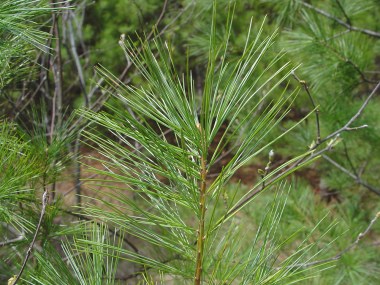
The trail narrows again and follows along a lovely, winding run through pines. We used to call this branch of the path “the nursery” because the ground is blankpinus-strobus-le-dcameron-b.jpgeted with hundreds of white pine saplings. Their spindle-needled fingers dance greenly on the breeze. This morning, Westley finds the thigh bone of a small mammal out here, licked clean, pristinely white. I’m guessing it once belonged to a house cat, or maybe a fisher cat. Coyotes and foxes live in this part of the woods.   If you walk through here at night, it must be like one of those old cartoons on TV: canine eyes blinking watchfully in the blackness.

Just past the nursery, we head gently uphill into my favorite portion of trail, a hilly glade dotted with towering white pines and fallen logs. The forest floor here is a layer of pine needles as deep as a duvet. Fallen trunks form bridges and tunnels that the kids used to like to climb on. This morning, Cordelia jumps up on one felled trunk and sticks her nose down a knothole, sniffing for squirrel. The trees are majestic. You sense their eyes on you, their rooted wisdom. You are just a hiccup in time.

At the top of this hill are “the blueberries,”  nooks and crannies of exposed granite boulders and low-blooming wild blueberry bushes. The birds always get the berries before we do. I like to stand in the clearing and drink in the height of this spot, taking a few deep breaths before turning back, feeling at one with the air and sky.  Sometimes I’ll do a sun salutation out here.

When we turn back, Westley runs all the way home. Cordelia loops around me in circles, trotting off into the woods and back to my side. My coffee is long since finished, and I itchily start to wonder how bad the deer ticks will be this year.

I’m grateful for the new day.

I’ll be back again tomorrow morning.


Cordelia

This little rescue dog who’s joFullSizeRenderined our family is a hoot. She’s terribly sweet and for the most part, calm, smart, and compliant. The rescue site described her as a “lab/shepherd cross.”  After meeting her, I thought: really?  Based on a little Google research, I suspect that she is 100% pure mountain cur. Curs are working dogs, bred for treeing squirrels and raccoons, essentially teeing them up for hunters. Our chipmunk population is on high alert. If you’re a varmint, don’t come scratchin’ around my garbage cans. Curs are known for their tenacity, and you have to be a strong pack leader to keep them in line. Oy.

For months, I’d been trolling dog rescue sites, pouring over profiles of assorted Jacks, Rileys and Mollys. I semi-ironically referred to it as my “dog porn.” I acknowledge there’s something a little unhealthy about speed dating dogs online, but as maladjustments to the looming empty nest go, I could do worse. With Mia heading to college next year, and John’s cluttered travel schedule, I want to have another presence in the house, more life, more noise. And frankly, I’d like an alternate source of entertainment for Westley, who drools on my leg as I write, looking up at me mournfully, hoping I will finish soon so we can go for another walk.   Of course, a second dog won’t fill the void of Mia’s absence, a gap so thunderously, cavernously, heart-crackingly wide that I don’t even want to begin to think about it. But a new canine pal may distract me a little, and if a dog in need gets a cushy home in Lincoln with good food, a soft bed, a buddy to play with, and daily walks in the woods, what’s the harm in that?

Here’s what we know about Cordelia. She was found wandering on a rural Tennessee roadside, and rescued by a sympathetic woman with friends in the local dog rescue community. They don’t know if she was abandoned, or just ran off and got lost. She has a scar on her snout they say is from a house cat, but if so, that was one big-ass kitty. Lisa, the good Samaritan who took her in, agreed to foster her for a while to see if she’d make a good candidate for placement up north, where scores of folks like me are scanning Petfinder sites with names such as “Buddy Dog” and “LastHopeK9,” looking for their “furever friend.” Lisa named her “Chloe.” (Coincidentally, this was the name of our first dog, a Bernese Mountain Dog who used to sit on my feet while I cooked dinner. I was constantly picking onion skins and tomato seeds out of her fur.) After “Chloe” was spayed and passed muster, Lisa handed her off to another foster situation at the home of a rescue volunteer named Muffin.

Muffin is a friendly, gravel-voiced, born-and-raised Tennessean. She has been fostering rescue dogs for two decades, and she currently has seven DOZEN of them living on her seven acre farm in Jackson, about 90 miles northeast of Memphis. “Not all of ‘em are allowed in the house, mind you,” she commented. “Only about thirty make that cut.”

The imagination staggers.

“We focus on good manners here,” she told me. “With this many dogs, I can’t tolerate any bad actors. You have to play nice and get along. We have guidelines, and every dog is expected to follow them.”

Muffin described Chloe as an easygoing dog; one who played well with others but could also back off. “She kinda follows the others’ leads, y’know?” We went down my checklist:  lived in a family home, okay with kids, well-socialized, medium energy, clean bill of health, no discernible problem characteristics, like resource guarding, aggressiveness or too much alpha energy. She was people-oriented, and had taken to sleeping in Muffin’s bedroom. It all checked out. Chloe was already on a transport headed up north. She was ours if we wanted her.

It was Mia’s turn to name a dog. Nate came up with “Hobbes” during a middle-school stint of obsessively reading “Calvin & Hobbes;” “Westley” was Lucy’s idea, for the dashing lead character in “The Princess Bride” whose alter ego is the Dread Pirate Roberts.  Mia chose “Cordelia” for Lear’s faithful youngest daughter: brave, noble, and true. Perhaps Mia identifies with the character, being herself our third and youngest child, and likewise protective, honorable, and so very big-hearted. As it happens, it’s also a fitting name for a Tennessee native.  As in: “Caw-DEEL-ya, you sho’ look purdy today!”

We brought Cordie home last Monday. She is affectionate and calm, but also playful and plucky. She likes the furniture – clearly it was okay with Lisa and Muffin for her to plop on any and every couch, chair or bed in the house.  She didn’t know any commands, but after only two days, she was rock solid on “sit,” and by today (day nine), she has mastered “down,” and is well on her way with “off” and “stay.” I hadn’t realized before now that Westley’s kind of a Matthew McConnaughy-type: he’s a looker, but not overly endowed in the smarts department.   Cordelia comes quite cheerfully when she’s called, and she doesn’t pull on the leash, which is a relief after sledding behind seventy-three pounds of golden retriever while leash training Westley. She has had a few house-breaking accidents, particularly after she’s been crated or left alone for a couple of hours, a sign of separation anxiety, I think.   And there is the not insignificant discovery that she has heartworm and will require several months of careful supervision while she’s treated, which we certainly didn’t anticipate. So much for the “clean bill of health,” but the rescue group has been great about it and is helping defray the cost. We could have surrendered her last week when our vet’s standard heartworm check came up positive. But that already seemed unthinkable.

For her first few days here, Cordelia didn’t show much interest in food, and she was tentative about going into certain rooms in the house.  But she’s starting to know this is her home.  Yesterday, I heard her bark for the first time, when the Invisible Fence lady was here slogging through the snow reflagging the property so I could start training her.  Today, she tore off down the driveway, barking happily at the UPS man.  Cordelia sidles up to Westley, tail wagging, and licks his drooly muzzle. They play just like siblings: it’s all wild fun, until somebody gets over excited and somebody else gets pissed.  That’s the two of them tussling over a tennis ball.  Sometimes they adore each other. Other times, I’mFullSizeRender-1 pretty sure their snuffles and grunts mean something along the lines of: “Mom! She bit me!” “Did NOT!” “Did TOO!” “Well he knocked me over…”
I really do miss those years with my three children all puppy-like, wriggling around my knees.


To the Beach

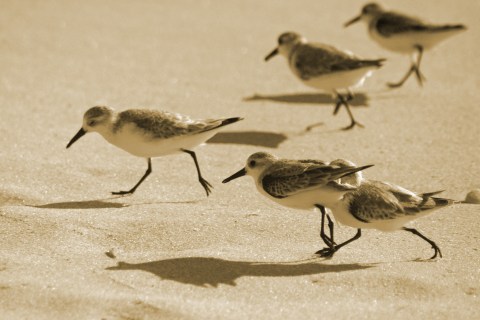
sepiagull-r1In Florida last week, we took a couple of long beach walks. One was aborted because I was coming down with the nebulous virus that plagued each of us to varying degrees: one of those illnesses where you feel off for a few days, a little dizziness here, some fatigue there, a persistent feeling of nausea that never materializes into a full blown stomach bug but puts you off food for a spell. The day we cut our walk short, we stopped on a deserted stretch of beach to wait out a surge of queasiness. We sat on a sand shelf up above the tideline and watched some sandpipers, their matchstick legs a blur as they zipped back and forth through the spindrift, racing up to the water line with each receding wave, and scurrying back to safety as new breakers rolled up the beach.

They are such busy little creatures. If you only watch their bird bodies, they appear to move in a completely horizontal fashion, like miniature speedboats racing on the surface of a serene lake. Yet their legs are constantly churning, churning, churning. Aren’t so many of us like that, whirring as fast as we can, yet presenting the impression that all is smooth sailing? I imagine a sandpiper’s natural facial expression, if she had one, would be a slightly manic, frozen grin, like the emoticon with all the teeth. As we watched, a trio of birds all went after the same buried snail. They scuttled up to the waterline and pierced the sand with their long snouts. One lucky guy came up with the prize, but the other two gave him a run for his money, pecking at his beak to dislodge the morsel. He came away victorious, trotting off beak held high, looking for all the world like a proud little mutt who beat all the Labradors to the tennis ball.

Both John and Mia lead sandpiper lives of late. John’s chief-of-staff went on maternity leave a few months ago, and he’s been doing the company-running part of his job solo, whilst also attending to clients, making pitches, giving speeches and seminars, flying to Houston today, Chicago tomorrow, Amsterdam next week. At the same time, he is working to develop a systems-based approach to social issues that arise from inequities like race and poverty. It’s a hard, hard job emotionally, because he’s a white male in his fifties and in his field, that’s an uneasy demographic; because he sees so much complexity and confusion, so many people of good intentions working at cross purposes; because problems like inner city kids not getting a fair shake with their suckish school systems are not easily solved, no matter what the politicians tell us about their better way; because he sets such high standards for himself. (A wife might say unreasonably high, but that’s a post for another day.) It isn’t exactly easy strategically, either. If it were simple to solve social problems, we’d have done it. He comes home from work exhausted. Straight after dinner, he heads for his laptop to plow through all the emails and attachments that heap up while he’s in meetings during the day. He plays a little tennis or reads a book before going to sleep, but other than that, he is tearing back and forth, chasing and running from waves, coming up with enough juicy tidbits to make the grind worthwhile. Yet he often feels like he’s just racing the tide.  And Mia is the consummate multi-tasking high schooler: directing a play, editing a literary journal, singing in three a cappella groups, doing her schoolwork with exacting standards, spending time with her friends and her boyfriend, binge-watching “Parks and Rec”, or “Friends” for the umpteenth time, deciding where to go to college, trying to steer through the shoals of anxiety, excitement, loss and gain that come with graduating from a high school that has been her second home. She juggles more balls than Ringling Brothers circus.  She is always tired.

The toll is different for people than for little birds, I imagine. Birds have to feed themselves, and this is how it’s done. We humans have a choice.  We can cut back, pare away, simplify. Doing so is a challenge. It goes against our culturally embedded Calvinist strain of work harder, do more, achieve more. Perhaps a remedy for sandpiper syndrome is to be more, maybe to take a vacation, even just for a few minutes, while sitting in your car or at your desk, and in your mind’s eye, watch the shorebirds as the waves roll in and out, and do nothing else.

in Time

It’s cool that there’s WiFi on the plane. And also a little creepy. There are so few spaces left where we are unreachable. The TV channels on JetBlue’s Hub broadcast today’s news. I don’t have to miss a beat. I can get off a flight better informed than when I boarded, after a busy day, stuck in traffic, caught up in my own head space of packing, planning, preparing. We’ll be landing two hours late, having flown a circuitous route out over the Atlantic to avoid “heavy air” inland, but the longer than usual flight is a chance to catch up.

I am flying to Florida for our almost-annual week’s vacation with my mom. I’m especially excited this year because my younger brother will be there with two of his three small children. They live in LA and I don’t like the distance: I can’t follow them on a day-to-day basis – their likes and dislikes, which stories or games are their favorites, their signature bon mots…those peculiar phrasings so charming in little kids.

12240284_10207852347450325_1462665332224023989_oI remember when their dad, my brother Welles, was their age. He is seven years younger than I, which is a hiccup in time now, but when we were kids, it was a chasm. He used to say, with great conviction, “I amn’t” instead of “I’m not,” a sensible contraction, when you think about it.  Welles has such an interesting mind, with a keen spatial and mechanical intelligence that I utterly lack. He can take apart a car engine or a camera and the parts will be strewn all over the place, looking to me like techno carnage.   But it makes complete sense to him and he’ll repair and reassemble it all in a heartbeat. When he was three or four, he built a beautiful Lego structure that resembled a helicopter/eighteen wheeler hybrid. He was sitting on the floor of our parents’ room, totally absorbed in the act of creation. Mom and Dad were still married at the time, and one of them asked him what he was building. Without missing a beat, he said: “it’s a contraption.” Big word for a little guy.

He still loves contraptions. He is a cinematographer by profession and rebuilds classic cars for fun. He taught himself welding so he could design a wrought iron gate for his house in Laurel Canyon. Now he has three children, seven years, three years, and seven months old. It pains me not to know their little eccentricities, their “amn’ts” and “contraptions.” His oldest child and only son, Sam, is a quirkster. Sam’s brain works on its own terms. He’s not the easiest child to parent, the kind of kid who keeps you up at night worrying – will he fit in, will his brain wire itself into something less contrarian, will he find friends and love outside the circle of family care? My kids are old enough now that I know the answer to these questions will be yes, ultimately. But there will be turbulence, no matter which route they fly.   I can’t wait to give Sam a big hug, and do my signature Donald Duck sneeze for him, which he loves. Or at least he used to love it, the last time I saw him. Now that he’s seven, he may have outgrown it.  That’s his sister Tess in the boots, in a photo Welles took.  She is more delicious than foie gras.  Also a classic bossypants, to hear her mom tell it.  I love a woman who knows her mind.

I’ll also see my niece Daisy in Florida. At 29, she’s the oldest of my nieces and nephews.   I was able to spend more time with her as she grew up, because my older brother Randy lives just under an hour away. I’ve seen her for scores of Thanksgivings, been to her youthful performances (a sequined, saccharin and epic Christmas review comes to mind) and her final high school viola recital. I attended her college graduation, when she was profoundly hung over but joyful, and have followed her career as a social worker with interest and awe. It’s hard work. She has a new guy in her life, and I hear from Randy that he’s good to her and they are happy. So I’m looking forward to meeting him.  My aunt-ly antenna are tuned: He’d better be good to her, because she is a pearl.

And then there is mom, who turned 80 in September. She feels fragile and vulnerable. Stuff goes wrong and she’s unused to it: a cataract here, a prolapsed this-or-that there, a skin lesion, a hernia, a virus that once would have been an annoying few days now is three weeks of bronchitis or worse.  I tell her she’ll never die, she’ll just keep shrinking until one day, she’s no bigger than Tinkerbell, all light.  And although she is more petite than ever, she is also more beautiful than ever. I somehow got watching the new Netflix series “Grace and Frankie” the other night and was struck by how much Jane Fonda reminds me of my mom. She doesn’t have mom’s sparkle though. Sorry Jane. Mom’s mind is sharp as it’s always been, which is saying something. She’s a thoroughbred, intellectually. I wish seeing her was easier.

But we all live a flight away. That’s how it is in this new millennium. So I’m up here at 35,000 feet, scribbling away, suspended in time. My seatback screen is tuned to CNN where the crawl informs me that the GOP conservatives are plotting to stop Trump with a “Unity Ticket”, Governor Snyder admits the state “messed up” in handling Flint’s water crises, and Bernie Sanders has conceded Missouri to Hillary Clinton. When we land, I won’t have missed anything important.

Love loss

I’m an optimist by nature. Some of that is personality, some life experience, and much of it, I’m learning from my neuroscience study, may stem from how my brain is wired. But I also believe in the power of spirit, of universal love, to overcome mean spiritedness, brutality, evil. And I don’t mean “believe” in a tooth-fairy or Santa Claus way, no matter what Bill Maher may say about faith. I’ve experienced miraculous redemptions, large and small, in my life, through love. Not rom-com style romance, or the easy-to-give devotion I feel for my children, my husband, my family, but the hard-won reconciliation that comes when I’ve sacrificed some of my precious ego-turf in the interest of repairing a rupture or healing a wound.   It’s happened many times in my marriage or family; it’s occurred with co-workers whom I was ready to throttle for mistreating me; it’s worked its magic in situations when I bit off way more than I could chew and doubted my abilities to handle a challenge, but stepped forward anyway because my help was needed. I can’t tell you the number of times love has delivered me from fear, rage, or despair.

I’m as susceptible to fear and loathing as anyone. I can be prone to self-righteous fantasies where I dress down some nincompoop I feel has abused me. I’ve day dreamed about having a conversation with the jerk who flipped me off in traffic: “Hey, who are you to do that to me? So you don’t like my driving, but for all you know, I might be the doctor who treats your elderly mom’s pneumonia. Or maybe I just got laid off, or had to put my seventeen year old cat ‘Miss Demeanor’ to sleep.   Who the f#%* are you to give me the finger?” It’s so easy to go that place, where righteous wrath roils, where we feel wronged and so surely it must be the case that we have been wronged, right?

Like so many of us, I’ve been trying to understand Donald Trump’s appeal. I hear Trump supporters interviewed who are angry. They like that he is a bull in a china shop. They often remark: “He says what we all are thinking but are afraid to say” – i.e. that other people are stupid, fat, losers, terrible, horrible; that Mexicans are rapists and all of Islam hates us and women are either hot, or dogs. These statements and the arrogant disregard for decency they represent are precisely what make people want to vote for him. So Donald Trump, in essence, is the untrammeled id of our nation. He is our worst, basest self. It makes sense that people are choosing him out of anger, because no one makes their best decision out of anger. Ever. That guy you slept with because you were so pissed at your ex? Not a good decision. The bender you went on after the client defecated all over your hard work, and then you called to give her a piece of your mind? Not such a swift idea.   The time you clicked send on a bellicose email to your child’s teacher and later found out that perhaps little Susie wasn’t so innocent after all?  Oops.  There are reasons why we can’t all walk around saying stuff like, “hey, yo, you fat, ugly moron, I hate your stupid, mean, sexist, racist ass,” even though we may be thinking it.

This hatred in our society stuns us all. I’ve tried to listen as impassively as I can, to be reasonable, to be curious about views that differ from mine.   I don’t want to meet hatred with hatred. It’s ineffective, for one thing. And it’s bad for my soul.  But I, too, am angry. I, too, feel that my country has been hijacked. I, too, despair that there is no relief in sight.

Today, the President did his job, as outlined by Article Two of our constitution, and named a nominee for Supreme Court justice.   Donald Trump, before he famously said “delay, delay, delay” about a potential Obama nominee, acknowledged that of course, he’d put a name forward if he were in Obama’s shoes.  Props to him for his candor on this particular point. And c’mon: What Republican President in the last six months of his tenure would sit back and say “not my job. Nope, I’ll leave it to the next guy-or-gal” ? It’s hypocrisy plain as the nose on your face when Mitch McConnell accuses Obama of politicizing the Supreme Court by naming a nominee. I ask you, in what universe is it not political to refuse even to hold a hearing on a nominee? You don’t have to confirm the guy, after all.  Mr. McConnell claims he wants the “voters to have a say” in the next Presidential election. The SIXTY FIVE MILLION Americans who voted for Obama (five million more than voted for Governor Romney) are no longer relevant, because it doesn’t serve Mr. McConnell’s politics, pure and simple. He certainly doesn’t care to give me a voice in this decision, since I voted for Obama and will most certainly vote for the Democrat this coming election, given the choice of Trump or Cruz. He is rolling the dice that we get a Trump presidency, I guess, and the Donald nominates Judge Judy or God only knows who.

160316_BT_merrick.jpg.CROP.promo-xlarge2It makes my blood boil.

And you know who loses in this scenario? Love loses.

I happened to be home this morning doing some paperwork, so I watched coverage of the President’s introduction of his nominee, Merrick Garland, while I was working. Judge Garland, of whom I never heard before this morning, has served our country–mine and yours, Democrats, Republicans, Trumpeters –with distinction, sacrifice and yes, love, for over twenty years. When he stepped to the podium to make his remarks, his voice cracked with emotion at the deep honor of being nominated to the Supreme Court. He teared up when thanking his wife for her support. This unassuming man presided over bodies being pulled from the Oklahoma City bombing site in order to better prosecute that case. He tutors inner city youth in DC. He is a brilliant legal mind, a moderate jurist, by all accounts a modest individual who is thoughtful and collaborative in style. NOT a kneejerk liberal. NOT an ideologue or an egotist bent on having his own way. NOT even a fifty year old with the prospect of thirty years on the bench.  News sources indicate many Republicans acknowledge him as a palatable choice, if they were inclined to uphold their constitutional duty of advice and consent by holding a vote.  He is the epitome of what it means to be a public servant.   Accepting this nomination, knowing that his considerable merits and his lifetime of service would be swept away on a tide of political posturing and bickering, may be his greatest sacrifice yet. Clearly, he has a profound belief in fairness (how ironic), or he would never subject himself to this process.  Seems to me like a pretty good qualification for a justice.

I feel gut-wrenching frustration over the vitriol and obstructionism to which we’ve sunk. It is heartbreaking. It’s childish, and as we are coming to understand, the unintended consequences (aka Mr. Trump) are dire.   We are wasting our time fighting the wrong battles, and the words of Lincoln, quoting Mark’s gospel,  come to mind: “A house divided against itself cannot stand.” But I refuse hatred. I reject racism, sexism, name-calling, rudeness, pettiness. I will work to prune my own righteous indignation because it can blind me. I will cultivate a desire for reconciliation, knowing that if we continue on this path of recrimination and blame, we are lost. I may be angry, but I stand for love.

Spring Forward

Happy Eve-of-Daylight Savings, everyone!  In the spirit of seasonal renewal, I’m gonna lay a little poetry on you.  Have a great weekend.  Go play in the sun.

Spring Forward

Moss in the noon sunfuzzy-rock
On the rock
in the yard:
A particular shade of yellow-green
Clings loosely
to the gray boulder,
like a throw
tossed over the back
of my chair.
Sunday,
the same light will fall
an hour later
on moss, rock, yard, grass.
My rose heart will open
and spring forward
out to the garden,
away from the blanketed chair,
under the sun,
into life.
It’s only a matter
Of time.

Jeepers Creepers


2015_global_temp_recap_animation_620Westley’s barking has worsened since I’ve been writing regularly. He finds it hard to tolerate my long stretches at the keyboard and like a spoiled child clamoring for attention he scratches at the door to come in, then go out, then in, then barks, then chews up a toy, then barks some more. In dog training circles, these are called “nuisance behaviors.” The solution is more exercise, more training, more structure and consistency. He needs to know who’s boss. He and I have similar challenges, it seems.

It makes John and me crazy when he starts barking at us before we’ve even had our coffee. The mornings here are serene: birds at the feeders, soft light filtering in through the skylight onto the heart pine floors, coffee brewing and the promise of a whole day ahead. Even though John has so much stress at work that his breakfasts are often spent plowing through email and writing presentations, there is a still a peacefulness to our —BARK BARK BARK BARK. See what I mean?

We’ve tried a bunch of different approaches to the barking.  All of them work, kind-of-sort-of, but then we get lazy, or he gets overexcited. You can’t let your guard down for one second with Westley. Our other dogs reached a point where they were trained, and it “held.” Not so with this guy. If you fail to reinforce a behavior you are working on even one time, fuhgeddaboutit. He has.

I’ve been trying to restructure our relationship. Dogs are sensitive and they know when you feel pissed at them, even though you’re doing your best not to let on. One solution I’ve been testing is to exhaust him early in the day by lengthening his morning walk.   Before I have coffee or look at the paper, when my vision is still blurry and my hair has that early-morning rumpled look that once was sexy but now is just unkempt, I yank on a pair of leggings and boots, and out we go on the trails behind the house, in the mist, in the mud, in the quiet.

But this morning, when we arrived at the little stream that feeds into an old cranberry bog, now a tangle of desiccated roots and vines, we heard the roaring chorus of spring peepers. Reep, reep, weep, chirrrrrup. Here’s what National Geographic has to say about our friend Pseudacris crucifer (Hyla crucifer):

 Found in wooded areas and grassy lowlands near ponds and swamps in the central and eastern parts of Canada and the United States, these tiny, well-camouflaged amphibians are rarely seen. But the mid-March crescendo of nighttime whistles from amorous males is for many a sign that winter is over.”

I am only somewhat heartened to read that this annual right of passage typically happens in mid-March. I associate their song with mid-April, when the snow has melted, the last frost is past. Yesterday it was nearly 80˚ in Boston. The sudden heat comes in the wake of a seesaw winter that saw some snow and cold, but mostly a weird soup of weather in the 40s and 50s. If I were disinclined to “believe in science” (that’s an entire post right there), then certainly the qualitative evidence of my daily walks would convince me: climate change is upon us, and accelerating quickly.   The NOAA reports that 2015 notched yet another “warmest year on record” – for the fourth time in this young century. In Australia, a molecular bioscientist and an economist have co-authored a study on personal energy consumption showing that disastrous levels of climate warming (the threshold of 2˚C) will be upon us much sooner than previously thought, possibly by 2020. In his book “Half Earth”, which I cannot read before bedtime or I won’t sleep a wink, Harvard biologist E.O. Wilson draws a stark picture of species loss in the biosphere and reminds us of our interdependence with the natural world: we are, after all, just another species.

Yet here in the US, we blather on about whether climate change is some sort of ideological plot being foisted upon the public. Our congress fiddles while the climate burns. Conservatives rant about job losses, as if this will matter if Mother Nature decides to give us the heave-ho right out of the Anthropocene age. (Sidebar: creating entirely new, sustainable energy industries will create jobs.)  People whine: why should we give up our toys—our SUVS and AC and LEDs– if they won’t do it in India or China.   Last time I checked, it’s called “leadership,” and it usually entails sacrifice and role-modeling, qualities in short supply in our legislature.  I am proud that President Obama and Justin Trudeau, that hottie from north of the border, this morning announced a pledge for the US and Canada to cooperate in combatting climate change.

A few weeks ago I had a dream. I was walking down a long drive lined with tall pines, seventy and eighty footers, with trunks as wide as refridgerators. All of a sudden, the trees starting falling, kamikaze-like, first one, then three, then five massive trees slamming themselves to the ground, roots upturned. In the dream, I was scared for myself as the earth shook with each tree fall. But I was mesmerized, too: they were so angry with us.

So I do not welcome this morning’s symphony of whistling peepers, quacking ducks and honking Canada geese. To my ears, these are the stark BARK BARK BARK of nature, clamoring for our attention while we drink our coffee and drive off into our small, busy lives.

********

A Child’s Poem
Inspired by A Walk on the Trails in Early March

Reap-weep the peepers cheep.
Quack-quack, the ducks talk smack.
And goose’s honky tonk cries
Scratch across the young March skies.
“Do you think you’re not of me,”
Asks Mother Nature, wearily.
“Species come and species go;
You’re not the only game, y’know.
So child of man, do not blame me
If you should burn. You fail to see:
I don’t need you. You’re not the whole:
I’ve foxes, fishes, egrets, voles,
Bacteria and bugs galore.
These other life forms don’t ignore
My rule, but they evolve. Yet sure,
You humans just take more and more.

A Stitch In Time

I’ve begun knitting again, after a hiatus of over ten years. It’s a tonic, in these carnival times.  I don’t think I could tolerate another debate freak show or election return without yarn in my hands to pacify me. The green wool feathers as I handle the work, nubby stitches, knit one, purl one. And so it grows: one stitch, one row, one skein at a time. I’m making an infinity scarf in a deep vibrant green. I can wear it next year when we sing at the Celtics, or for the occasional excursion with John up to Hanover for a Dartmouth football game.   I’ve never had anything appropriately green for either of those gigs.

When the work is long enough, I’ll give it a twist and seam the bound off edges. The stiches bubble into rows under my fingers as I go. Can it really be that I made each one? I am uninterested in each little loop-wrap-pull for its own sake. It amazes me how these modest seeds add up to a whole piece. Sometimes, I drop a stitch, or twist the wool, or make some other rookie mistake. A veteran knitter, like my kids’ handwork teacher in elementary school, could diagnose my messes in a snap, “Oh look, you picked up a stitch from the row below,” or “you purled twice here.” But it takes me many rows to notice the glitch in my pattern. It’s a drag to undo the work, the yarn squiggly like an old-fashioned landline telephone cord. There is an ever-present danger of unraveling more than I intended and being unable to thread the loops back onto my needles. Sometimes, you have to make a choice: pull five rows to get back to that one dropped stitch that now winks at you like a toothless gap in a child’s smile; or carry on, choosing to view the bare spot as beautiful, an inevitable part of the hand-made whole. You can always darn it later. But old perfectionists die hard, so I usually opt for the fix.

The other day on the train home from New York, I was knitting while also watching a video lecture for my neuroscience course. (By the way, I’ve learned that multi-tasking is kind of a myth. We are simply single tasking in slivers, rapidly switching from task to task. It feels as if we are doing many things at once, but in reality, we’re just micro tasking. It is less efficient, brain-wise, than doing each job on its own with full attention.) The lecture was the first in a series addressing the topic of plasticity: what happens to our neurons when our brain “rewires,” for example, when a stroke victim relearns how to talk by utilizing a different part of his brain?  What activities should we choose if we want to cultivate the “plastic” ability of our brains?

In the video, our professor announced that this week’s homework is to select a long-term project that retrains our brain. Learning to juggle is a classic brain training activity, but I assume this would edscf0493.jpgntail dropping a lot of balls, not a good choice when you live with a two year-old golden retriever. Since I was already knitting, I thought, why not teach myself to knit left-handed, right here and now? And I leapt in, connections in my brain as tangled as fingers and yarn. Not such a swift idea. Not only did I grasp next to nothing from the lecture, I made an unholy mess of my scarf.  I wound up pulling out about two inches of stitching. I felt infantilized by the task, which is actually good news from a neuroplasticity perspective. Challenge, even (or perhaps especially) to the brink of failure, is a critical element of brain rewiring.

Rather than ruin the scarf, which is two-thirds finished, I’ve decided to teach myself to crochet left-handed. I have never so much as a held a crochet needle before, so this should be interesting. It’s a little granny-like, I grant you, but in my minds’ eye, I’m creating lacily hipster tea cozies and darling stuffed animals for my wildly successful Etsy business (is there such a thing?) At the very least, a crocheted blanket for my baby niece seems like a project that can take me through Election Day. Before we get to that point, there will be much unraveling, I’m sure.