Day Nineteen: Monkey Doorway

I don’t know why, but my keys wouldn’t open the studio door this morning. This same set worked just fine last Tuesday morning. I misplaced them for a few days later last week and borrowed a replacement set from Maria, who owns the studio, last Friday. Students were starting to arrive, so thank goodness I just happened to have the replacement set. What kismet! What serendipity! Don’t you just love it when the universe blows you a kiss like this?

Except they didn’t work either.

I called Maria and she called the landlord, who said he could be there in 10 minutes. It was now 10:05 and our hour-long class was supposed to start at 10:00. There was one student who’d only taken class at the studio, and I was very conscious of not wanting her to feel we are some fly-by-night, wacky operation. There we were, in this not-so-nice hallway that is essentially the backstage space of a former auto dealership converted several years to retail space. It’s now home to a couple of gift shops, a flower shop, the studio, and an auto body shop. The hallway has never been ready for primetime, although the tenants have done what they could to add attractive touches, and the landlord did repaint it a cheery soft yellow. Nonetheless, the floor is covered with industrial grade carpet and plastic boot mats, the hallway is long and narrow and the only natural light comes from a single window in the door out to the alley. Only some of the fluorescent ceiling fixtures work.

It’s funny (or perhaps, this is the truly synchronous happening of my day), but I’d been thinking a lot about space in the car on the way to class this morning. A number of women who are regular members of the studio community (and this studio is very much that) have been batting about ideas around maybe renting a space for a women’s collaborative, so that’s one reason it was on my mind. I’d also begun this morning’s post thinking about a particular space: the one between my intent to write a blog post a day for a month and my actual tally. (Today is February 22. This is post nineteen). That irksome gap of three.

Spaces are so interesting. They contain, they define, they explain, they can expand and contract. In music, they are everything: intervals, rhythms, rests. Space in dance is much like in sculpture: a play between negative (empty) and positive (full) space. Composition in art as in music is much about how you perceive and manipulate the spaces. I had set the focus for the day’s class as this: exploring the spaces we create when we move and sensing our bodies as solids that move through open places. It sounds kind of abstract, but it’s actually really cool. You can play with it right now: just spread the fingers of both hands as wide as you can and then “touch” the space around you, almost like you are finger painting, or miming. Then let your fingers come back together and do the same thing, as if you are carving the air with the outside edge of your hand. It feels different, right? Not better, not worse, just different. Your relationship to the space around you and within your body just changed somehow. That interests me.

Back to our narrow hallway: We had enough space to move, so why not just start class out there? Four students had come, their time was valuable after all, and the teacher in me wanted them to have the fullest class possible. I have been in classes halldancewith three of them many times before and they are awesome ladies. I knew they’d be up for it. Our new guest was sure to jump on the train if we all did. So we fired up some music on my Iphone and began.  This is us:

We physically touched the walls in front of and behind us. Familiar moves – Nia steps that we do all the time – were transformed when you could touch both the wall in front of you with your hands and the one behind you with your foot at the same time. There was something special about it. Noralee jumped up on a bench and took some pictures on her phone. I think we all may have been a little disappointed at first when the landlord arrived and unlocked the door for us; I know I was.

It did feel great to move into the studio, to be in the light, to have all that beautiful, airy room to sculpt with our movements, expanding our boundaries. One of the songs towards the end of the class, when we were cooling down, has this very odd lyric that I’ve never quite been able to  understand. The lyric is sung in Sanskit, I think, but there’s a line that sounds like the vocalist is singing “In a monkey doorway…” in perfect English. And so this is how I’ve come to think of it (like that lyric in Springsteen’s “Blinded by the Light” that my teenage friends and I always thought was “ripped up like a douche”–ewwww—but we’d sing it out full voice anyway, which we thought was hilarious).  Which begs the question: what is a monkey doorway? To me, it’s the benevolently disruptive entrance into another dimension or mode of perception. (Because: monkeys!) Basically, a paradigm shift. You don’t necessarily recognize it when you’re at the threshold, but you know when you’ve crossed over.  Kisses from the universe.

Day Eighteen: Near Miss

Fallen treeIf troubles come in threes, then hopefully, we’re done.

It was nearly 60 degrees yesterday, another hide and seek Boston winter day, climate-change style. John has a Pavlovian response to such weather: the faintest scent of spring inexorably draws him, work-gloved, to the yard. So he headed outside among the little mounds of not-quite melted snow and not-yet picked-up dog poop that cover the squishy lawn, determined to clear up some of the fallen limbs littering our property after the snow. The most recent snowstorm followed a week of unseasonably mild weather, and the boughs were pliable under the heavy, wet snow. Branches as solid as ten inches in diameter came cracking down from the white pines and sugar maples that ring our house.

I assumed he planned to drag the fallen limbs over to the brush pile we have accumulated in the woods just beyond the landscaped edge of our yard. I did not know he intended to take on a topped-off Norway maple. The thirty footer had cracked at the trunk about two thirds of the way up, and the broken section nose-dived, top-first, down to the ground, where what had been upwards arching branches now impaled the soil. I promise you, if I had known he was going to attempt to cut this down, I would have done my utmost to dissuade him: “this is too big a job for one man, even you.” It is not likely I’d have succeeded. John is literally (and conveniently, at times) deaf in one ear. He is also more stubborn than a berry stain.

Spoiler alert: this story is going to the emergency room. Meta-spoiler alert: A compressed fracture of the T12 vertebrae. It could be better. But it sure could have been worse. No head injury, miraculously. The upended trunk – about 8” in diameter and 12 feet long, fell on his left shoulder but somehow completely missed his skull. We went out there and looked at it today, trying to figure out how such a large object could have fallen onto him from such a height and missed his head. We decided it must have collapsed at an oblique angle to his shoulder when he cut away one of the branches. It looks as though an offshoot, rather than the trunk itself, is probably what hit him, although he still bore the full weight, trunk and all. He seems to be feeling okay today, getting around fine, just a bit stiff, a little swollen around his shoulder blade.

I don’t want to dwell on the drama: EMTs rolling the gurney across the grass (John says he was thinking, “Fuck, they are going to leave ruts in the lawn.”), neighbors striding up from the road in concern when they saw the ambulance, or John staring daggers at me because I insisted he needed to go to the hospital to get checked out – by a DOCTOR. (“I’m fine,” he growled, “Look I can walk fine.” He said this while seated, looking pale, sweaty, pained.) I do want to dwell on the blessing. The whole time we were at the ER, I felt a stunned sense of gratitude that we were simply feeling irritated with the long wait time, rather than pouring over CAT scans showing bleeds and trauma.

For the car ride home, John had to wear the clothes he’d had on that afternoon when he’d fallen. They were clammy from melted snow, and he shivered loudly, teeth rattling while I blasted the heat as high as it would go. Shock.
Life can change in an instant.

There’s a song by Ingrid Michelson that our girls used to listen to a lot. It’s been playing silently in my head today:

We are so fragile,
And our cracking bones make noise,
And we are just,
Breakable, breakable, breakable, girls and boys.

And yet, we are so strong.

Day Seventeen: Playdate

I also teach a modality called “Ageless Grace,” a brain and body fitness class that’s great for neuroplasticity (the brain’s ability to rewire itself through movement, in a nutshell.) Yesterday, two sixty-something year- old public school drama teachers who are buddies showed up at class for the first time. These gals were all in: without hesitation, they mimed playing baseball, violin, conducting traffic, swan-diving and synchronized swimming. They made scary faces and blew kisses, pretended to have temper tantrums and to dance the mambo. They were having a ball. Their enjoyment was infectious for most of the other students.

One woman, also 60-ish, was far more reserved. She joined in every exercise, but often with a disdainful expression, as if she was thinking “this is so stupid.” I’ve learned not to let my ego go on a tear whenever a student in one of my classes is clearly not into it. The classes are outside the mainstream for many people, beacause they are about presence and play, with no other endgame. We don’t keep score, no one wins or loses, there are no metrics to determine if we are improving or not. There’s only this: how do we feel? Are we having fun? Are we doing our best? This is unfamiliar terrain for some people.

At the end of class, Two-Drama-Gals asked me to tell them a bit about how Ageless Grace developed, and I gave them the spiel about the founder, how she is from Raccoon Valley, Tennessee, that she became interested in gerontology because of her own aging parents, how her background as a movement teacher led her to study neuroscience, then she piloted the program for seven years with a Duke University-affiliated hospital. What neuroscience research is increasingly discovering, I explained, is that the best thing you can do for longevity and brain health is exercise that simultaneously works the body and the brain in spontaneous ways. This is true whether you are a middle-aged-to-old fart trying to stave off your increasing sense of stupitude — forgotten names (like, your brother’s), lost keys, whole conversations completely unremembered, the sum of two plus four; or a little kid learning a new skill.

“Oh,” said Drama-Gal-Number-One matter-of-factly, “so you mean, you have to play.”

So much for all my jargon.

“It’s such a shame,” she further commented. “Kids I teach now, it’s much harder to get them to play then it used to be. They have trouble accessing their own imaginations, with all this technology.”

Now that’s sad. People without confidence in their own imagination can be easily influenced, for one thing. I look back on my childhood and it seems all I did was play. I was alone a lot, but I was constantly acting out stories or building vast imaginary worlds in my head. My three kids, too, did a lot of playing. They were big into dress-up, elaborately staged Beanie Baby plays, forts, and bizarro games they simply made up. Like “Baker Heads,” in which Nate and Lucy wore Mia’s Pampers “Pull-ups” on their heads, their faces framed in the leg opening (this made them look like 18th century toothache patients), and talked in funny high-pitched voices. They found this hysterically funny.

Afterwards, the woman who had seemed uncomfortable in class hung around while I did some paperwork and prepared to close the studio. She has a tall, lanky frame and diffident manner. Together, these give her the air of a watchful stork. I would have thought she would be the first one out the door, but she was the last.

“I want you to know,” she confided. “I very much enjoyed myself.”

Not what I expected to hear.

“I’m so glad,” I said.

She hesitated, and then continued: “I have a very difficult time playing. I always have, even when I was a child.”

“Well, you did great just now,” I told her. “And good for you, you did something difficult today, taking this class. That was brave.”

She did her best. We all do what we can.

Now run along and play.

Day Sixteen: Ground Control

I was heading out the door to teach my 8:30 a.m. class this morning when Mia called. The instant I saw her number at that hour, I knew: fender bender. A minor dust-up in the Dunkin Donuts parking lot involving a blind spot in our CR-V, morning sun glare, and senior spring (friends, academics, theater, no downtime, lack of sleep, college uncertainty all swirled into a frothy blend of anxiety-latte). In a panicky voice, she told me she was this close to a meltdown. In her case, once the train gets up a head of steam for meltdown station, you just have to buckle up and wait for the ride to end. Telling her to calm down (she would if she could) or trying to reassure her verbally is unhelpful to her. She purses her facial muscles and presses the heels of her hands against her brow, as if she is literally trying to hold herself together. Her breathing shallows; everything makes her angry, mostly with herself for being unable to control her rising sense of panic. If she could only breathe more deeply, release her muscles instead of trying so hard to contain herself. But she is too caught in her head.

By the time I had pulled into the parking lot at the club where I teach Nia, a text confirmed she was safely at school and presumably, feeling better. I was now the one who was rattled. I was running late. I hadn’t had time to prepare, check my playlist, craft a focus for this morning’s class, or plug in to my own sensations. Even though I hadn’t had any coffee this morning, I felt over-caffeinated and jittery.

In Nia, you have permission to teach the class you need to take. Chances are, if it’s what you need, everyone else does, too. It never fails to amaze me how true this is – Jung’s web of associations. The second I stepped out of the car and my foot met the pavement, it came to me, almost in a jolt: I need to get grounded. My energy is staticky and all over the place – who knows who I might inadvertently shock if I don’t close the circuit and ground myself?

Grabbing the mic and heading into the studio, I was stopped by a lovely, high-energy “regular” who always dances with delight and is especially light on her feet. She wanted to apologize that she might not participate with her usual verve this morning. She tucked aside her blonde bangs to reveal a nasty gash in her eyebrow. Ouch! On Monday, she’d walked smack into the corner of a kitchen cabinet at her house. “I guess I just wasn’t being mindful,” she said thoughtfully. I laughed with her: I think perhaps you weren’t being body-full. It’s the same thing for Mia when her anxiety mounts: she loses a sense of being tethered to her body, anchored and safe. Her mind, if anything, is too full. As was mine, when I was sitting in the parking lot, feeling rattled and unfocused, chasing a nestful of rabbit-thoughts down their little holes: should I call Mia? Should I text one of her friends to make sure she settled down? Should I call our insurance agent? How much was this going to cost us? Could I focus for class? Were my students going to have a lousy class because my mind was so jumpy? Did I remember to put Westley back inside before I left home? Oh, crap, did I forget my Ipad?

In class, we focused on feeling the hardwood boards under our bare feet, on sensing our leg and buttock muscles and their connection to the floor. We scooped up armfuls of air and brought our palms together to close the circuit. We squatted down and placed our fingertips on the floor, grounding hands and feet, feeling the solidity of the earth underneath us. We stomped our feet and shimmied our shoulders and played with the contrasting sensations of being supported and solid from below, and freaking out into the space around our heads, hands swatting imaginary bees from around our ears. We stood still and listened to the music, grounding in sounds and melody. We dug in our heels, as if the floor was wet sand. We danced, bodies-full.

Day Fifteen: Braggadocio

Decorative-fontsI got bogged down today writing about “The Body Politic”, a topic that so incenses and ennervates me, I had to take a power nap at 4:30 this afternoon, leaving me still postless at 6:30 p.m.. This is the effect our discourse has on me physically: depression, restlessness, frustration. I know I’m not alone in this — our body politic is sick. We all feel it, red or blue, liberal or conservative. It’s the slow drip of impotence, of continually being stoked into fear, rage, or both. The worst symptom of our disease is a desperate, ginned-up sense that we are each other’s enemies, that we hate our very selves, simply because we have (admittedly big) differences of opinion. But we also have a lot of common interests, ones that our national body is too flu-ridden to breach. With polls taking our god-damned temperature every five minutes, our feverishness is continually reaffirmed; there is no cool cloth on the forehead in sight. It got to me today, but I hope to rally tomorrow.
Now, for something lighter, since I don’t want to fall behind my posting goal by yet another day. Instead of a rant, here’s a little ditty about the fun side of making words appear on the screen. That’s a kind of embodiment, right? I wrote it awhile ago, so it’s a bit of a cheat. But it reminds me that although our politics make life feel surreal and so-very serious these days, there is still fun to be had, pleasure to be taken in inconsequential things.

Fontastic!

The blank page is white.
I can fill it, though,
With little dots and scrawls of black
In a Myriad of fonts:
Calibri, Mistral, Ayuthaya, Chancery.
Evoking world travels at the click of a dropdown.
Will one of the Gothics take me to the moors—
Bell, perhaps, with its mournful toll?
Bodoni wears a crumpled hat in the Tuscan sun,
Head nodding after the midday meal, yet oddly delicate:
He’s gay.
(His friend Petrucci, the musical one? Also gay.)
Britannic bold has a bosom as deep as a library shelf,
Leading pallid schoolchildren through the British war museum,
The walls shake.
Adobe Hebrew? Clearly reformed.
What of Blackmoor LET, traipsing about the medieval fair,
With his trained falcon, Charlemagne, and multi-pierced lady-fair,
Lucida Blackletter?
And those lush-sounding girls:
Euphemia, Georgia, Gabriola, Mona Lisa (she’s solid), Constantia, Candara,
And their slightly hipper sisters, Onyx and Tahoma,
Sitting in the window, languid, heavy-lidded, waiting to be chosen
As that square-assed bitch Helvetica gets the job again and again.
Her or Arial (who at least is clean)
Not a single curve on them; go figure.
I told my students, when briefly I had them,
A font-change does NOT count as a revision.
Yet I, too, can feel the pull of sunnier climes: Lithos and Arno
Beckon away from the work at hand, a novel, screenplay,
Or high school essay on how Iago seduces, or Hamlet fails.
Cracked is how I’ll feel writing at two a.m. after
Drinking too much Chicory, when the world sleeps
And all is
Braggadocio.

Day Fourteen: Look!

print-eye-flickr-kevindooley

I am appreciating my eyes lately. They are funky, but they do the trick. I am farsighted, with an astigmatism in one eye (I forget which, which is probably fodder for a post about the state of my memory), and something called “deep cups” in my retinas which give me a higher than average risk for glaucoma. Over the last year, I also developed “narrow angles,” which essentially means there is less space in my eyes as I age. As a result, the drainage angles that keep pressure from building up on the optic nerve could suddenly close off. That would be really, really bad.

When my ophthalmologist gave me this latest diagnosis, he was pretty low-key.

“We have a new little problem,” he said.

So my first question for him was “how suddenly” can these drainage routes close off. Like, today, tomorrow, next week? I feel fine. I have no sense of building pressure, that at any minute, I’m gonna blow, spewing eyeball-stuff all over the place, B-rated horror movie style. (Of course, that’s not at all what happens.) My vision is kind of wonky, but I’m in my mid-fifties. They say the eyes are the first thing to go, right?

No clear answer. This is why glaucoma is so tricky. You don’t know the disease is progressing until you notice vision loss, and at that point, the damage is irreversible.

The treatment for my narrow angles is something called an iridotomy. The surgeon burns a tiny hole in your iris with a laser. The hole acts like the valve on a pressure cooker, letting off steam as necessary so that the whole thing doesn’t just explode. They give you some numbing drops (of dubious effectiveness), sit you in the exam chair, place a lens on your eye to help aim the laser, and then zap your iris about ten times to make the hole.

“Don’t flinch,” said my ophthalmologist.

It’s rare to have any side-effects from an iridotomy. My guy has done over a thousand of them, and “maybe twice” had patients who developed a minor issue with glare after the procedure.

Meet lucky number three. After undergoing the iridotomy in my left eye, I noticed a hazy halo arcing up from the bottom of my field of vision, but only in certain lighting conditions. Snow, night driving, sunset. Basically, when the light hits my eye from a low plane, I get this little glare-flare. It’s not the end of the world. At some point, my brain will apparently figure out how to work around it and I won’t notice it any more. I don’t have cancer or a degenerative nerve disease, my joints are in great shape, I sleep pretty well, and aside from gray hair and progressive lenses, I feel like I’ve always felt. Timeless, pretty much.

Yet I find myself looking at things more closely, particularly when I am out walking the dog on the trails: a Milky Way spray of bubbles trapped beneath the skin of ice formed on the surface of a stream; brown hemlock needles caught in a frosty spider’s web; an orphaned ski glove wedged in the upright fork of a spindly tree, as if waving. I practice noticing. Can I see the individual leaves on a tree? The numbers on the speedometer? The faint freckles on my daughter’s nose and cheekbones?

Day Thirteen: Let It All Hang Out

Here’s a thing about women’s bodies after 50: the muffin-top. You know it, that little extra sumpin’ that rolls out over the waistband of your jeans or yoga pants. It’s not fat, necessarily, just slippage. The muffin-top has a corollary, bra-bulge: those rolls that bubble up from under your bra straps, giving your back that nice topographical look you’ve never wanted.

It’s new to me, this feeling that my own flesh is on the loose, literally. I sit down and it sort of squirts out between my bra line and waistband, giving me the overstuffed sensation you might get after Thanksgiving dinner. It makes me feel matriarchal, but in a good way, uninhibited. I guess I am on my way to being one of those unfiltered late-50 something gals who just puts it right out there. “Wow, your new haircut is a shot in the dark!”; “That dress must really have been on sale!”; “I see why your son doesn’t have a girlfriend.” This must be the definition of “let it all hang out,” when your own flesh is just going for it and the rest of you can’t help but follow suit.

Which brings me to Spanx. Hollywood starlets who couldn’t pinch an inch of flesh if their lives depended on it are wearing girdles. When asked “Who are you wearing tonight” on the red carpet at a recent awards show, one little slip of a thing answered brightly: “Isaac Mizrahi and Spanx!” These are young, fit women, who just happen to have, um, skin. God forbid our attention should be drawn to the fact that there’s as much of it under their clothing as they expose.

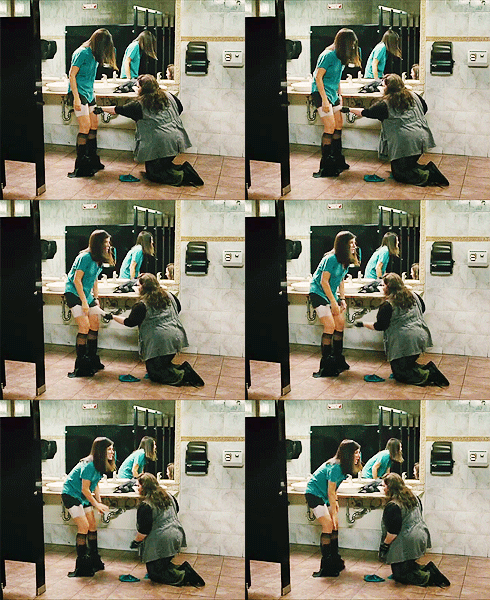
In the girl-cop buddy movie, “The Heat”, there’s a scene where actresses Sandra Bullock and Melissa McCarthy are changing in a restroom. Bullock, uptight and whippet-thin, is scooching into her Spanx. McCarthy, larger than life in body and in character, watches on skeptically.

giphy-1

McCarthy: “Jesus, what are those?”

Bullock: “They’re my Spanx. They hold everything together.”

McCarthy (incredulous): “Why? What’s gonna come popping out?”

So I have worn a Spanx or two in my time. I know what Ms. Bullock means about being held together by a nice compression foundation garment. It can be oddly comforting. But ultimately it brings me no joy. Heck, the brand name is a little masochistic: Punish me; I have a stomach. Even “control top” nylons evoke the sense that something terrible could happen without them. I may lose control and just dissolve into—what? Tears? Unpleasantness? Or dare I say it, be a bitch? My inner feminist rages. Men just let that big ‘ol beer gut loll over their belt buckle almost proudly, sloshing around as they walk. They don’t care that the sight of all that flesh going off-leash might offend. Is there such a thing as Spanx for men–some steel-reinforced spandex product that compacts their unsightly bulge into a more manageable package? If so, I doubt its sales rival those of Spanx. I resent feeling that I need to be shmushed into place. At my age, all Spanx really do anyway is relocate the spillover to another quadrant. They make me sweat. They cannot be great for my circulation, and they do nothing for my ego. It’s a love/self-hate thing. I have to own that I am complicit in my self-constraint.

Maybe we should all stage a coup and burn our Spanx, 70’s-style.

Day Twelve: Body Language

Today is Feb. 15, and this is my twelfth post. I’m thinking “one post a day” describes the final tally and not daily output. So sue me.

Mia has an English paper due tomorrow. The topic she’s come up with for the essay is body language in the novel “Native Speaker” by Chang Rae-Lee. I’ve not read it . From what she has told me, I know it deals with the experience of Korean-American immigrants and the role of language in defining their identity. I love this idea that our native language might not be the one we grow up speaking, but in fact, our body language. I’m really proud of Mia for her insight in picking up on its importance to the characters in this book.

It’s got me thinking.

Now this is maybe a cop-out for the fact that I have not managed to sit down and write daily, but I have been doing a lot of teaching over the last few weeks. My teaching of Nia is every bit as immersed in language as a long session at the keyboard. The act of speaking with my body throughout the class unlocks words and images in a steady stream. When I am seated at the keyboard, the words come more haltingly. For example, I just finished a sentence and my mental energy flagged. I picked up some nearby nail-clippers and worked away on my cuticles, girding for the next round of composing. This small physical act relieves the constant, quiet tension that is a ghost looking over my shoulder as I write; I feign disinterest so that perhaps he’ll be distracted and wander off to haunt someone else.

But my mini-manicure also grounds me in the here and now, in something physical and ordinary. That’s helpful. Staying connected to my sensations as I teach, waiting for language to arrive that enhances the movement (or perhaps it’s more accurate to say that language flowers out of the movement–metaphors are the actual fruit of my dance), the words flow. On the best of days at the keyboard, I achieve this same sense of becoming a conduit for language and ideas: I’m just providing the vessel here, but the words themselves come from a divine source. In dance, I have this feeling ALL THE TIME. The words move through me, they are unique to me, yet they are not mine at all.

Day Eleven: I Lied

FullSizeRenderI lied in my prior post. To quote: “I typically have great eating habits.” It’s true that I am well informed about good nutrition. My favorite food group is vegetables. I don’t drink soda or ever eat fried or fast food. If faced with a choice between a plate of sautéed kale and a cheesesteak grinder or a slice of pizza I will choose the kale every time, on one condition: it’s ready NOW.

Otherwise, all bets are off. Habits-schmabits.

If I had a personal chef, I’d be leaner than a greyhound. You know that game kids sometimes play: if you could only have three foods with you on a desert island, what would they be? Mine would be arugula, summer-ripe cherry tomatoes and a good, strong-bodied hard cheese, like a nice parmagiano reggiano. It about kills me to have to eliminate olive oil from this list, but I’m hoping I can create a reasonable substitute on my island – maybe it’s an undiscovered desert island somewhere in the Mediterranean that just happens to have a grove of wild olive trees? I figure I can forage for nuts, berries and other greens, I can make salt from the salt water, and since it’s an island, there should be plenty of fish, so I’m good there. In other words, I am not bringing a lifetime supply of Pringles, or Skippy peanut butter, or even sirloin steak. My instincts are good.

Here’s the reason why I lied when I wrote that I have great habits: When under stress, I am a pantry junkie – usually when I am rushed for time, but also when I’ve let it go too long since I last ate, or when I am anxious. (As an aside, I rarely get hissy-fit level anxious anymore—thanks, menopause! But anxiety is the ambient soundscape of my psyche, rarely rising to a level above the gentle sussuration of an ever-present breeze. Which can be annoying.) Say I am coming in the door from a meeting that ran overtime – the traffic was bad and now it’s 5:30 and dark and I still have to walk my dog but I am ravenous and there really isn’t time to make a nice green salad with cherry tomatoes, olive oil, a few strips of parmagiano reggiano and a slice of lightly sea-salted grilled fish. I am resentful, because I would really prefer this. But there’s shit I gotta do. So I open the pantry door. It starts off reasonably well: a few nuts. I mentioned I am ravenous, right? So, oh look: Mary’s Gone Crackers. Gluten free, loaded with seeds and nuts, with a satisfyingly molar-engaging crunch. Still not too bad, right? But my impatience and irritation with the fact that I don’t have time to make myself a nice little meal right now so often lead me further down the pantry shelves to: chips. Tortilla, potato (we don’t often have those, but when we do, I’m a goner), pita. And you need cheese or salsa to go with those, right? Before you know it, I’ve spent as long standing in front of the pantry mindlessly munching as it would have taken to make the desert island meal of my dreams.

It’s a habit I’d like to break.

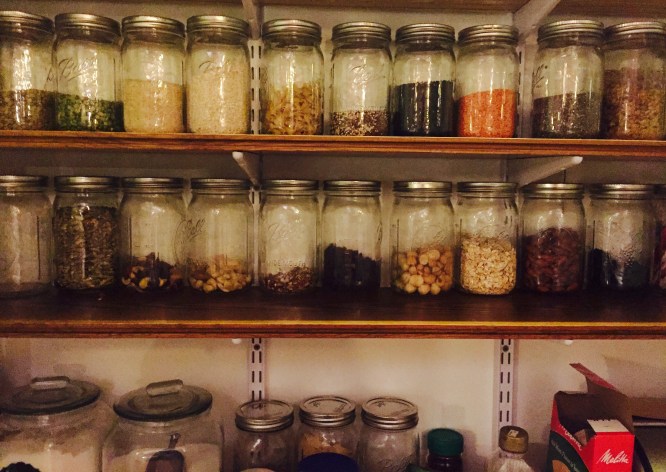
P.S.  That’s my pantry above.  It looks so innocent…


Day Ten: Feeling Blocked

Words just aren’t coming to me today. I have no sense of purpose. What good is a blog when you have nothing in particular to say? (I’ll bet you’re really eager to read on now. Go ahead, spend another five minutes of your life reading a useless post by a flailing author.) This is what it’s like inside a writer’s mind. This is how we think. Well, I’ll speak for myself: shiftless, meandering, lazy, uninteresting, wooden, who cares, vanilla – just a sampling of the adjectives that seize at my gut like bacteria, making it damned challenging to digest ideas, to stomach my own words. I am a harsh critic of my little baby ideas. I cannot imagine being nearly so impatient with anyone else, standing behind them tapping my foot dismissively as they struggle for words. Never in a million years would I abuse a young child attempting an uncharted challenge. But I can rip my infant essay in to shreds with bearlike tenacity, leaving claw marks on my psyche and little clumps of fur on the keyboard.

So here’s what writer’s block feels like in my body. 1. Restlessness is the first symptom. I don’t like my chair. I think I’ll clean off my computer screen. Okay, I’ll open up the document and maybe re-read something I wrote a while ago. Oh, hey, that’s not awful. It’s pretty good. Did I write that? Huh, so I’m not lower than shit in a 50 year old cesspool, I guess I’ll just start writing now. But this feels terrible. I have nothing to say. I can’t get the metaphor quite right so I type “metaphor here later”. Oh my god, I have to get up. I don’t care what Anne Lamott or Steven King say about keeping your butt in the chair because I cannot tolerate one more second at this keyboard. I have GOT to get up and…what? It doesn’t matter. Maybe I need to empty the dishwasher. I don’t like how that pile of mail looks so sloppy and asymmetrical; I’ll just align the edges of the envelopes—oh, look at this mailer; Premium Pro Paint company is having a winter special, two rooms for the price of one. The family room could definitely use a fresh coat. Do we have another room that needs painting? I should walk around the house right now and check. I think I hear the damn dog at the back door again — didn’t I just let him out 10 minutes ago?

Restlessness is inevitably followed by a secondary symptom:

2. Imaginary hunger. I am hardly ever physically hungry. The appetite that surfaces with writer’s block is a kind of emotional emptiness that has my chin covered in potato chip crumbs before it’s actually registered in my brain that I have crossed the kitchen, opened the pantry doors and pulled out the bag. Typically, I have great eating habits. Except when I’m anxious. And a session of writing rarely, if ever, begins without anxiety. Ergo, chips. Or nuts. Or crackers. Or CHEESE. Love cheese. I’m a morning writer, but if my sessions were in the afternoon, I’d be reaching for the cookies no question. And on the few occasions when I’ve left my writing until after dinner, the the wild Chardonnay stalks me. (I completely get why so many writers are drunks, addicts, or otherwise neurotic. I do not understand the ones who are well-balanced, productive, and high-functioning.) For me, indulging any of the above appetites leads to:

3. Indigestion, self-criticism, and a deep sense of ennervation. None of these lends itself to flowing prose.

4. Repeat sensations 1-3 as necessary.

5. Here’s the magic: who knows how or why, but if I can manage to tolerate these physical twitches and emotional discomforts and stay at the keyboard, some alchemy takes over and I lose myself. I am neither embodied nor disembodied, just quiet and focused. Hours can go by and I have no sense of time or bodily need of any kind. It’s heavenly.