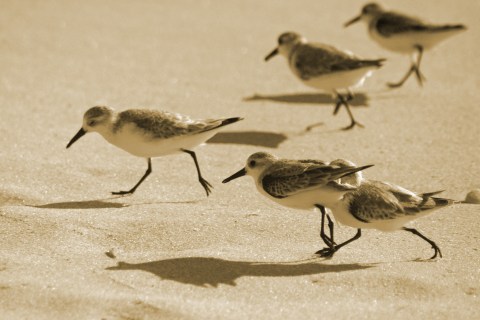
 In Florida last week, we took a couple of long beach walks. One was aborted because I was coming down with the nebulous virus that plagued each of us to varying degrees: one of those illnesses where you feel off for a few days, a little dizziness here, some fatigue there, a persistent feeling of nausea that never materializes into a full blown stomach bug but puts you off food for a spell. The day we cut our walk short, we stopped on a deserted stretch of beach to wait out a surge of queasiness. We sat on a sand shelf up above the tideline and watched some sandpipers, their matchstick legs a blur as they zipped back and forth through the spindrift, racing up to the water line with each receding wave, and scurrying back to safety as new breakers rolled up the beach.
They are such busy little creatures. If you only watch their bird bodies, they appear to move in a completely horizontal fashion, like miniature speedboats racing on the surface of a serene lake. Yet their legs are constantly churning, churning, churning. Aren’t so many of us like that, whirring as fast as we can, yet presenting the impression that all is smooth sailing? I imagine a sandpiper’s natural facial expression, if she had one, would be a slightly manic, frozen grin, like the emoticon with all the teeth. As we watched, a trio of birds all went after the same buried snail. They scuttled up to the waterline and pierced the sand with their long snouts. One lucky guy came up with the prize, but the other two gave him a run for his money, pecking at his beak to dislodge the morsel. He came away victorious, trotting off beak held high, looking for all the world like a proud little mutt who beat all the Labradors to the tennis ball.
Both John and Mia lead sandpiper lives of late. John’s chief-of-staff went on maternity leave a few months ago, and he’s been doing the company-running part of his job solo, whilst also attending to clients, making pitches, giving speeches and seminars, flying to Houston today, Chicago tomorrow, Amsterdam next week. At the same time, he is working to develop a systems-based approach to social issues that arise from inequities like race and poverty. It’s a hard, hard job emotionally, because he’s a white male in his fifties and in his field, that’s an uneasy demographic; because he sees so much complexity and confusion, so many people of good intentions working at cross purposes; because problems like inner city kids not getting a fair shake with their suckish school systems are not easily solved, no matter what the politicians tell us about their better way; because he sets such high standards for himself. (A wife might say unreasonably high, but that’s a post for another day.) It isn’t exactly easy strategically, either. If it were simple to solve social problems, we’d have done it. He comes home from work exhausted. Straight after dinner, he heads for his laptop to plow through all the emails and attachments that heap up while he’s in meetings during the day. He plays a little tennis or reads a book before going to sleep, but other than that, he is tearing back and forth, chasing and running from waves, coming up with enough juicy tidbits to make the grind worthwhile. Yet he often feels like he’s just racing the tide. And Mia is the consummate multi-tasking high schooler: directing a play, editing a literary journal, singing in three a cappella groups, doing her schoolwork with exacting standards, spending time with her friends and her boyfriend, binge-watching “Parks and Rec”, or “Friends” for the umpteenth time, deciding where to go to college, trying to steer through the shoals of anxiety, excitement, loss and gain that come with graduating from a high school that has been her second home. She juggles more balls than Ringling Brothers circus. She is always tired.
The toll is different for people than for little birds, I imagine. Birds have to feed themselves, and this is how it’s done. We humans have a choice. We can cut back, pare away, simplify. Doing so is a challenge. It goes against our culturally embedded Calvinist strain of work harder, do more, achieve more. Perhaps a remedy for sandpiper syndrome is to be more, maybe to take a vacation, even just for a few minutes, while sitting in your car or at your desk, and in your mind’s eye, watch the shorebirds as the waves roll in and out, and do nothing else.
 I remember when their dad, my brother Welles, was their age. He is seven years younger than I, which is a hiccup in time now, but when we were kids, it was a chasm. He used to say, with great conviction, “I amn’t” instead of “I’m not,” a sensible contraction, when you think about it. Welles has such an interesting mind, with a keen spatial and mechanical intelligence that I utterly lack. He can take apart a car engine or a camera and the parts will be strewn all over the place, looking to me like techno carnage. But it makes complete sense to him and he’ll repair and reassemble it all in a heartbeat. When he was three or four, he built a beautiful Lego structure that resembled a helicopter/eighteen wheeler hybrid. He was sitting on the floor of our parents’ room, totally absorbed in the act of creation. Mom and Dad were still married at the time, and one of them asked him what he was building. Without missing a beat, he said: “it’s a contraption.” Big word for a little guy.
 It makes my blood boil.
 Westley’s barking has worsened since I’ve been writing regularly. He finds it hard to tolerate my long stretches at the keyboard and like a spoiled child clamoring for attention he scratches at the door to come in, then go out, then in, then barks, then chews up a toy, then barks some more. In dog training circles, these are called “nuisance behaviors.” The solution is more exercise, more training, more structure and consistency. He needs to know who’s boss. He and I have similar challenges, it seems.
 ntail dropping a lot of balls, not a good choice when you live with a two year-old golden retriever. Since I was already knitting, I thought, why not teach myself to knit left-handed, right here and now? And I leapt in, connections in my brain as tangled as fingers and yarn. Not such a swift idea. Not only did I grasp next to nothing from the lecture, I made an unholy mess of my scarf. I wound up pulling out about two inches of stitching. I felt infantilized by the task, which is actually good news from a neuroplasticity perspective. Challenge, even (or perhaps especially) to the brink of failure, is a critical element of brain rewiring.
 On the train to New York, woods, towns, water are all a blur. I am listening to the Hamilton soundtrack – we are going to see it tonight. It’s very difficult not to rock out to the music, even though I’m in the quiet car. Every so often, I start a little rhythmic shoulder-rolling or head-bobbing because I can’t help myself. I remember once when I was a teenager, my mom danced up the aisle at a movie theater. “Omigod, mom, please stop before I die,” I inwardly cringed. But John, seated with me as I pop and sway, seems nonplussed.
 My friend Lisa arrived at the nine a.m. class this morning fresh from voting. “I did something I’ve never done before in my life,” she announced, one eyebrow cocked naughtily. “I voted in the Republican primary. My little stake in the ground for sanity,” she said. She voted for John Kasich. More accurately, she voted against the Donald. In Massachusetts, “un-enrolled” independent voters like Lisa (and me) get to choose which party’s primary to vote in, on the spot. Some diehard Democrats even changed their party affiliation to un-enrolled just so they could cast a vote against Donald Trump.
 all just accept that there are going to be a few surprises, I think it’ll go okay.” She then opened up those glorious pipes and delivered every kind of amazing artistry you could imagine: country, yodeling, Broadway, lyric, opera, and standards. Her rendition of Irving Berlin’s “Always” was lump-in-your-throat simple and sincere. She raised the roof with the signature title ballad from “A Light in the Piazza.” An opera major in university who had her premiere at the Met last year, she flawlessly navigated a hilarious country-opera hybrid (“it’s like Oprey, with an ‘A’”, she twanged in one lyric), soaring from hillbilly into an aria of incredible texture and precision. As the evening wore on, she started to run aground more often, her voice refusing to show up in a certain range, or sometimes (and I think this was maybe more disconcerting to her) croaking out before she could steer it back onto solid ground. She would acknowledge these glitches with a wry tilt of her head, without missing a beat. Even though she was only able to perform at a fraction of her usual capacity, it was more than enough. As John said in summary, “60% of Kelli O’Hara is like 5,000% of anybody else.”
 A Body Story